
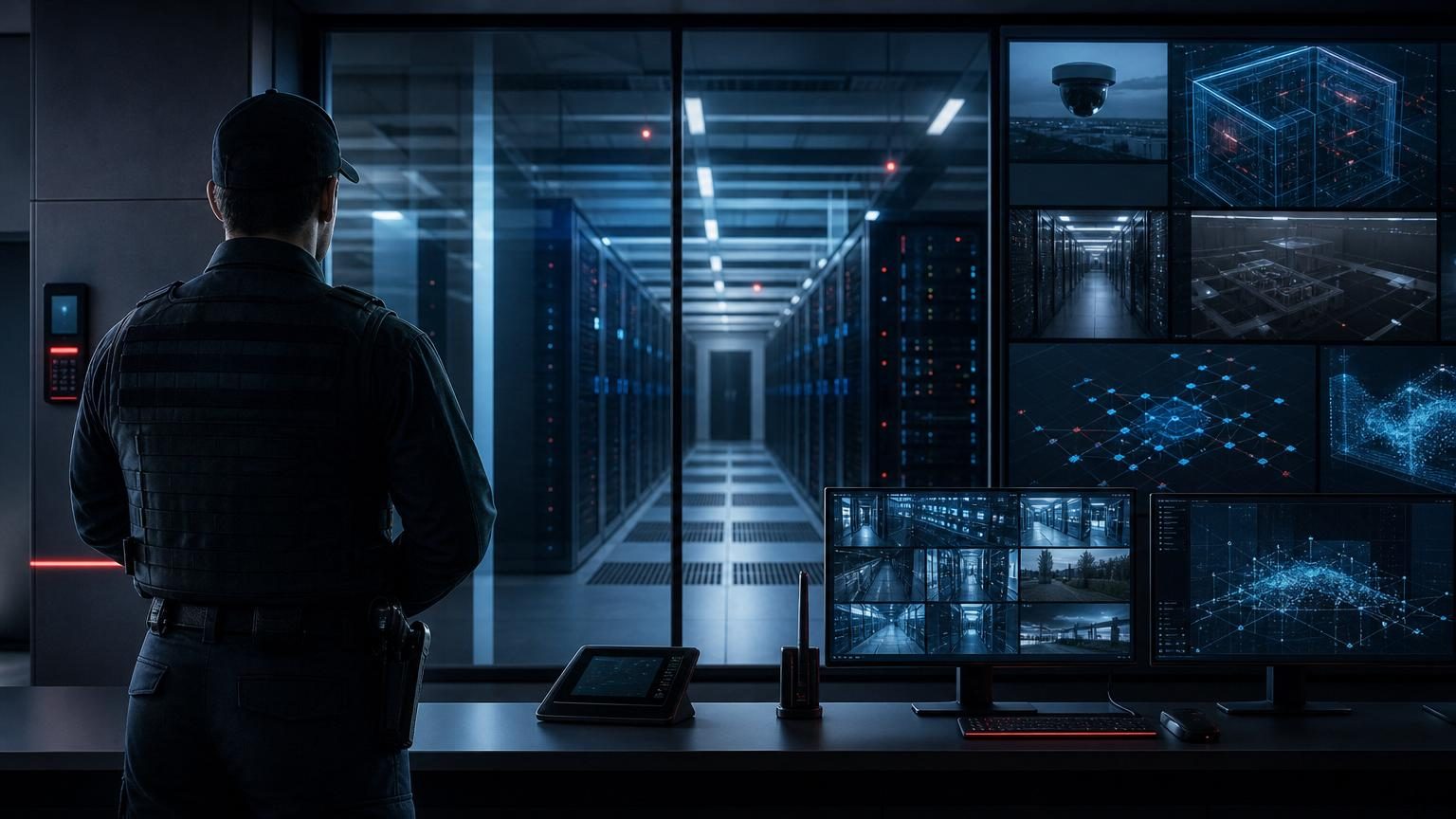
Physical Security in Data Centers Is Not a Commodity Problem
A colocation facility is not a warehouse. It houses infrastructure that supports financial transactions, healthcare records, government systems, and enterprise operations for dozens or hundreds of tenants simultaneously. A single unauthorized access event, an insider threat, or a coordinated intrusion can trigger contractual liability, regulatory exposure, and reputational damage that outlasts the incident itself.
Yet many data center operators still approach physical security the way they would a suburban office park — a guard at the front desk, cameras on the perimeter, and a monitoring contract with whoever offered the lowest annual rate. That gap between risk profile and security posture is where incidents happen.
This post outlines what a serious physical security program looks like for colocation and enterprise data centers, and where human officers, remote monitoring, and AI-assisted tools each carry their weight.
Guard Services: The Baseline That Still Matters Most
No technology replaces a trained officer making a judgment call in real time. For data centers, guard services typically cover several critical functions:
Access verification and escort control. Officers stationed at entry points verify credentials, cross-reference approved visitor logs, and escort non-badged personnel through sensitive areas. This is not a task you automate away — it requires human judgment when credentials are expired, when a vendor shows up unannounced, or when someone’s behavior warrants a second look.
Roving patrol. Interior and exterior patrols on randomized schedules deter opportunistic threats and catch physical anomalies — propped doors, unsecured equipment bays, unfamiliar vehicles in loading areas — that fixed cameras miss or flag too late.
Incident response. When an alarm triggers or a situation escalates, an on-site officer can respond in seconds. A remote operator can call 911. The difference in outcome between those two scenarios is significant.
SecTek deploys both armed and unarmed officers at data center facilities depending on the client’s risk assessment, tenant requirements, and local threat environment. For colocation facilities serving federal agencies or financial institutions, armed presence is often a contractual or compliance requirement, not a preference.
Remote Monitoring: Coverage Without Proportional Headcount
A large data center campus — multiple buildings, loading docks, parking structures, generator yards, cooling infrastructure — cannot be staffed at every point around the clock without prohibitive cost. Remote monitoring fills that gap.
SecTek’s 24/7 monitoring operations center provides:
- Live video surveillance across camera networks
- Real-time alarm response and triage
- Two-way audio intervention for deterrence before an officer or law enforcement arrives
- Escalation protocols tailored to each facility’s response plan
The value of centralized monitoring is consistency. A fatigued officer on hour seven of a twelve-hour shift misses things. A monitoring center with defined protocols and supervisor oversight does not have the same degradation curve.
For colocation operators managing multiple sites across regions, remote monitoring also provides a single operational picture rather than siloed, site-by-site awareness.
Access Control Integration: Where Physical and Digital Meet
Access control is often managed by the data center’s IT or facilities team, with security treated as a downstream consumer of that data. That separation creates blind spots.
SecTek works alongside existing access control infrastructure — card readers, biometric systems, man-trap configurations, visitor management platforms — to ensure that the human security layer is synchronized with the electronic one. Officers need to know when access events are anomalous: a badge used at an unusual hour, a credential presented at a door it has never accessed before, a tailgating event the system logged but no one acted on.
When access control data flows into the monitoring operation and is visible to on-site officers, response time to anomalies drops and false positives get resolved faster. That integration is a process and communication problem as much as a technology one.
AI-Assisted Surveillance: Useful Tool, Not a Replacement
AI-based video analytics — object detection, loitering alerts, perimeter breach detection, license plate recognition — have matured enough to be operationally useful. They reduce the cognitive load on monitoring staff by surfacing relevant events rather than requiring eyes on every feed simultaneously.
SecTek incorporates AI-assisted surveillance tools as a force multiplier for human operators. In practice, that means:
- Automated alerts routed to monitoring staff for review and action
- Behavioral analytics flagging access patterns that warrant officer attention
- Perimeter detection that triggers response before someone reaches a door
The limitation worth stating plainly: AI systems generate false positives, require calibration for each environment, and cannot make the contextual judgments that determine whether a situation is a threat or a maintenance crew working late. Human oversight is not optional — it is the point.
The hybrid model works because it assigns each layer what it does well. AI handles volume and pattern recognition. Officers handle judgment and response. Monitoring staff handle coordination and escalation.
What Data Center Operators Should Evaluate
If you are assessing your current physical security program or selecting a new provider, these are the questions that matter:
- Does your guard force have documented data center-specific training, or are officers rotated in from general commercial accounts?
- Is your monitoring operation staffed 24/7 with defined escalation protocols, or is it a passive recording service?
- Are your access control systems integrated with your security operations, or are they managed in separate silos?
- Does your provider have experience with the compliance frameworks relevant to your tenants — SOC 2, FedRAMP, HIPAA, PCI DSS — and understand how physical security controls map to those requirements?
SecTek works with colocation facilities, hyperscale operators, and enterprise data center teams across the country. If your current program has gaps in any of these areas, the conversation is worth having before an incident makes it urgent.
Tags: data-centers, operations, technology