
The Industry Is Older Than Most People Realize
Private security predates modern policing by centuries. Long before municipal police departments existed, merchants, landowners, and governments hired private individuals to protect property and enforce order. Understanding that lineage matters because the core problem has never changed: public law enforcement cannot be everywhere, and the people and organizations with the most to lose have always found ways to fill that gap.
Ancient and Medieval Roots
The concept of hired protection is as old as commerce itself. Roman merchants employed private guards to protect shipments. Medieval guilds organized watchmen to patrol market districts after dark. Feudal lords retained armed retainers whose job description would be recognizable to any modern security director: deter threats, control access, and respond when deterrence fails.
What these arrangements lacked was standardization. Quality, accountability, and training varied entirely based on who was paying and what they could afford. That problem persisted for a very long time.
The Pinkerton Era and the Birth of Modern Private Security
The clearest ancestor of the modern private security industry in the United States is the Pinkerton National Detective Agency, founded in 1850 by Allan Pinkerton in Chicago. Pinkerton built something genuinely new: a professional, organized, multi-city investigative and protective service operating on a fee-for-service basis.
The agency’s early work included protecting railroad shipments, investigating theft, and—most famously—providing security for President-elect Abraham Lincoln during his 1861 journey to Washington. Pinkerton agents uncovered an assassination plot in Baltimore and rerouted Lincoln’s travel accordingly.
By the late 19th century, Pinkerton and its competitors were deeply embedded in industrial America. Mining companies, railroads, and manufacturers hired private guards to protect facilities and, in some cases, to manage labor disputes. That latter role generated lasting controversy and shaped how regulators and the public viewed private security for decades.
The Aftermath of Industrial-Era Abuses
The use of private guards as strikebreakers—most notoriously during the 1892 Homestead Strike, where Pinkerton agents and striking Carnegie Steel workers exchanged gunfire—prompted Congress to pass the Anti-Pinkerton Act in 1893. The law prohibited the federal government from hiring private detective agencies for certain functions. It remains on the books today.
The episode established an early and important lesson: private security operates within a social and political context. Overreach invites regulation. The industry’s credibility depends on maintaining a clear boundary between lawful protection and conduct that substitutes for legitimate authority.
World Wars and the Professionalization Push
Both World War I and World War II accelerated the growth and formalization of private security. Defense contractors, shipyards, and munitions plants needed protection that the military and local police could not provide at scale. The federal government actively encouraged private guard programs at critical facilities.
After World War II, returning veterans brought military discipline and training into the private sector workforce. Guard companies began developing standardized training curricula, uniforms, and operating procedures. The industry started to look less like a collection of individual arrangements and more like a coherent profession.
The 1970s: Regulation Arrives
By the early 1970s, private security employment in the United States had grown large enough to attract serious policy attention. A 1972 report by the Rand Corporation, commissioned by the federal government, documented the industry’s size and raised concerns about inconsistent training standards, inadequate screening, and unclear legal authority.
State legislatures responded with licensing requirements, background check mandates, and minimum training hours. The standards varied widely by state—a patchwork that still exists today—but the direction was clear. Private security was no longer operating in a regulatory vacuum.
Technology Changes the Work
The introduction of closed-circuit television in the 1970s and 1980s began shifting how security work was actually performed. A single operator could monitor multiple locations simultaneously. The economics of surveillance changed.
Access control systems followed. Electronic keycards replaced physical keys. Alarm systems became networked. By the 1990s, a mid-sized commercial building might have a control room that looked nothing like the guard shack of twenty years earlier.
The internet era accelerated this further. Remote monitoring became practical across geographic distances. Video analytics began automating tasks that previously required a human watching a screen. Today, AI-assisted surveillance systems can flag anomalies, track movement patterns, and alert operators to specific behaviors without continuous human attention.
What Technology Has Not Replaced
None of this has eliminated the need for trained officers on the ground. Technology identifies; people respond. A camera can detect an unauthorized entry, but someone has to make contact, assess the situation, and decide what happens next. The officer-technology relationship is complementary, not competitive.
Where the Industry Stands Now
The U.S. private security industry employs roughly three times as many people as public law enforcement. That ratio reflects a straightforward reality: the demand for protective services exceeds what government agencies can supply, and it always has.
What has changed is the sophistication of the work. Modern security programs integrate physical officers, remote monitoring, access control, and data analytics into layered systems designed around specific threat profiles. A hospital has different requirements than a data center. A multifamily property presents different challenges than a federal facility.
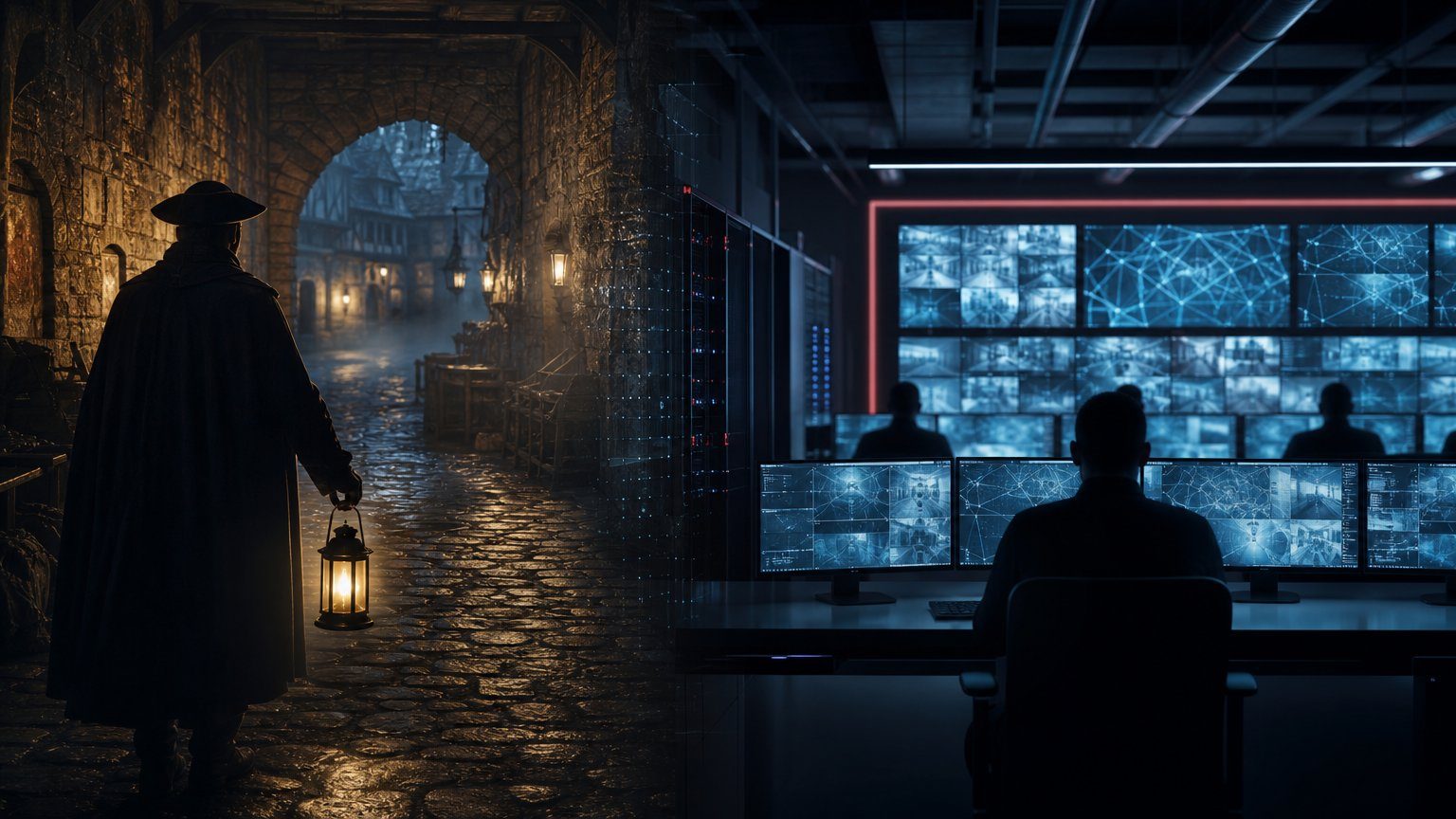
The history of private security is largely a history of the industry adapting to those differences—learning from failures, absorbing new technology, and building the professional infrastructure that clients now expect as a baseline. The night watchman with a lantern and the AI-assisted monitoring center are separated by 200 years and connected by the same underlying problem.
Tags: operations, technology, leadership