
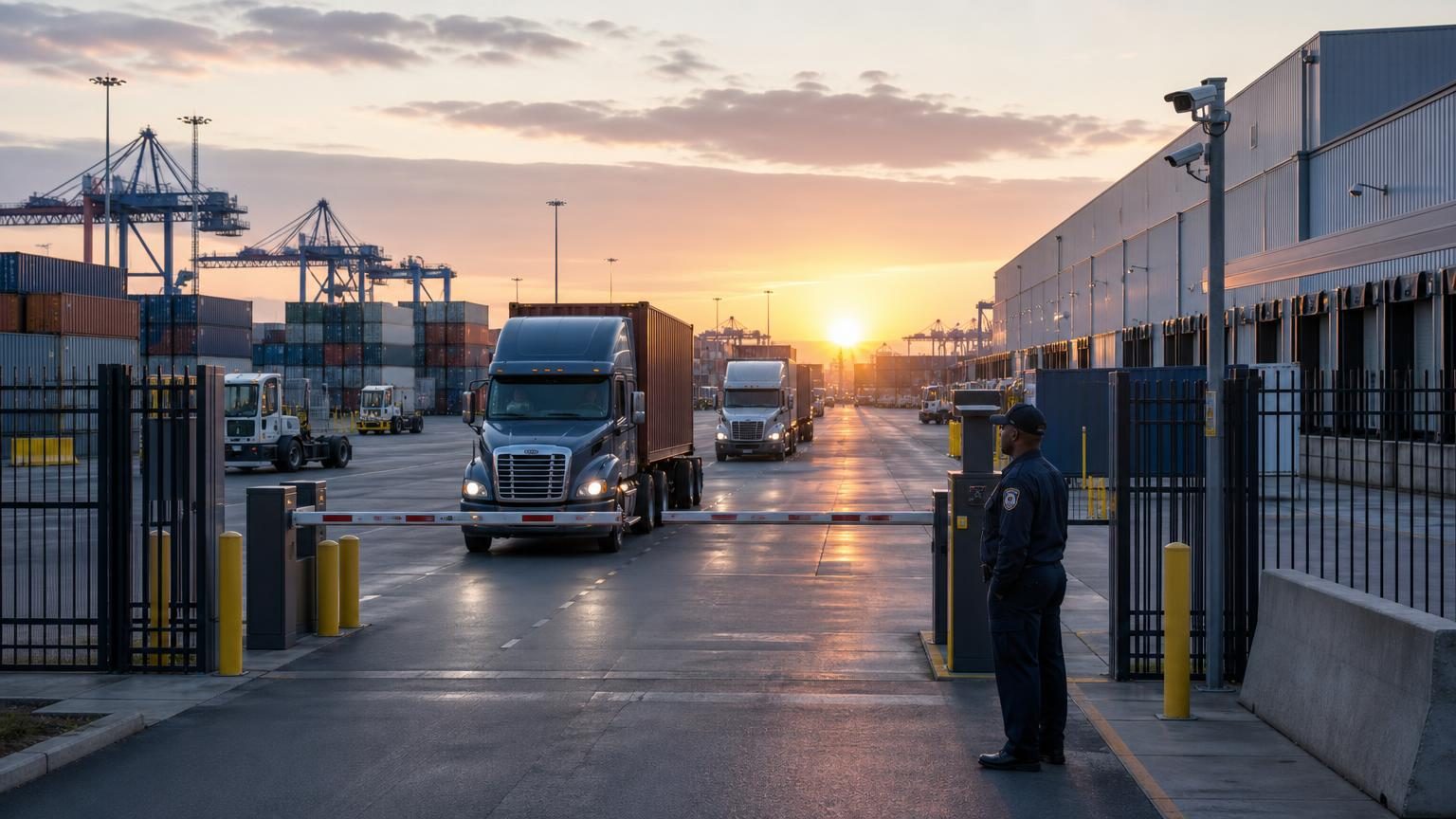
A port, logistics hub, warehouse, or manufacturing facility does not have the luxury of treating security as a stand-alone function. Every gate decision, visitor check, patrol route, alarm, and incident report affects the flow of people, vehicles, cargo, and production.
That is why effective security in these environments has to do two things at once: protect the facility and support the operation.
The security challenge at the edge of the supply chain
Logistics and industrial sites bring together conditions that create a demanding risk environment:
- Continuous or extended-hour operations
- High volumes of employees, contractors, drivers, and visitors
- Multiple vehicle and pedestrian access points
- Valuable inventory, equipment, data, and infrastructure
- Large footprints with loading docks, yards, parking areas, and restricted zones
- Time-sensitive production and delivery schedules
At a port or port-adjacent facility, those challenges become even more complex. Security teams may need to support changing operating conditions while facility leadership works within the federal maritime security framework. The U.S. Coast Guard’s Homeport resources help maritime stakeholders navigate requirements under the Maritime Transportation Security Act, while the Coast Guard’s MARSEC levels establish graduated protective measures when risk changes.
The lesson for every logistics and industrial operator is straightforward: a static, one-size-fits-all guard plan is not enough.
Start with disciplined access control
The gate is one of the most important control points in a logistics operation. It is also where security can either strengthen the business or create unnecessary friction.
An effective access program should define how the facility verifies employees, contractors, vendors, visitors, and vehicles. It should establish clear procedures for deliveries, after-hours entry, rejected credentials, lost badges, escorts, and emergency access. At facilities with multiple tenants or buildings, those procedures must be consistent enough to enforce and flexible enough to match each zone’s risk.
SecTek combines professional personnel with entry and exit management to help clients control the movement of people and vehicles while maintaining operational flow. Officers can manage employee entrances, loading docks, vendor access, credential checks, and escalation procedures without losing sight of customer service.
Build layers beyond the gate
Access control is essential, but it cannot see everything. Large industrial and logistics properties need overlapping layers that reduce blind spots and help teams respond quickly.
A strong program may combine:
-
Trained on-site officers. A visible, professional presence helps deter unauthorized activity and provides immediate judgment when conditions do not match a checklist.
-
Roving patrols. Mobile patrols extend coverage to yards, fence lines, equipment areas, loading zones, and other locations that fixed posts cannot continuously observe.
-
Monitoring and alarms. Cameras, sensors, and alarm systems help detect conditions that require investigation, especially after hours or across a large footprint.
-
Real-time reporting. Timely, useful reports give facility leaders visibility into incidents, recurring vulnerabilities, and officer activity.
-
Clear response procedures. A detected event only becomes a managed event when the security team knows how to verify, escalate, communicate, and document it.
SecTek brings these layers together through armed and unarmed security officers, roving patrol and response, and security monitoring and response services. The result is a program designed around the site rather than a collection of disconnected services.
Protect continuity, not just property
The cost of a security failure is not limited to stolen inventory or damaged equipment. A poorly managed incident can interrupt production, delay shipments, affect employee safety, trigger regulatory scrutiny, or damage a customer relationship.
For that reason, security planning should begin with operational questions:
- Which entrances, processes, and assets are essential to continuity?
- Where could one unauthorized person or vehicle create the greatest disruption?
- Which areas become vulnerable during shift changes or peak delivery windows?
- How should security coordinate with safety, facilities, operations, and local responders?
- What information does management need during and after an incident?
- How will the security posture change when threat conditions or operating schedules change?
The best security partner is one that understands these questions and turns the answers into post orders, staffing plans, technology, supervision, reporting, and measurable performance.
Why SecTek is built for logistics and industrial security
SecTek has provided security services since 1992 and has experience supporting automotive manufacturers, logistics hubs, chemical processors, warehouses, government organizations, and other complex environments. That breadth matters because industrial security officers need to understand more than patrol technique. They must operate professionally around production schedules, safety requirements, commercial traffic, vendors, employees, and sensitive areas.
SecTek stands apart through a combination of:
Sector-specific experience
SecTek understands the pace and complexity of industrial, manufacturing, and warehousing operations. That experience helps teams recognize site-specific risks and adapt security procedures to the realities of the facility.
Customized, risk-based planning
Every property has a different footprint, operating rhythm, threat profile, and budget. SecTek builds staffing and security plans around assessed risk instead of forcing every client into the same template.
Trained and vetted professionals
SecTek provides trained armed and unarmed officers selected for the environment they will protect. They can support access control, emergency response, patrols, surveillance, reporting, and other critical tasks.
Technology-enhanced accountability
AI-assisted surveillance, GPS confirmation, real-time electronic checkpoints, and reporting tools can improve situational awareness while giving clients clearer visibility into service delivery.
Scale with local responsiveness
With security forces serving more than 350 locations, SecTek has the reach to support multi-site operations and the flexibility to respond as staffing needs, schedules, and risks change.
An employee-owned culture
SecTek is an American employee-owned company. That structure reinforces a culture of responsibility, client satisfaction, and long-term performance—qualities that matter when a security provider becomes part of daily operations.
The right program keeps business moving
Ports, warehouses, logistics hubs, and industrial facilities are critical links in the supply chain. Their security programs should be just as disciplined, adaptable, and accountable as the operations they protect.
SecTek combines experienced people, proven processes, modern technology, and tailored planning to protect facilities without losing sight of the mission: keeping people safe, assets secure, and operations moving.
Learn more about SecTek’s industrial, manufacturing, and warehousing security services and start a conversation about a security program built for your operation.
Tags: port security, logistics security, industrial security, warehouse security, supply chain